
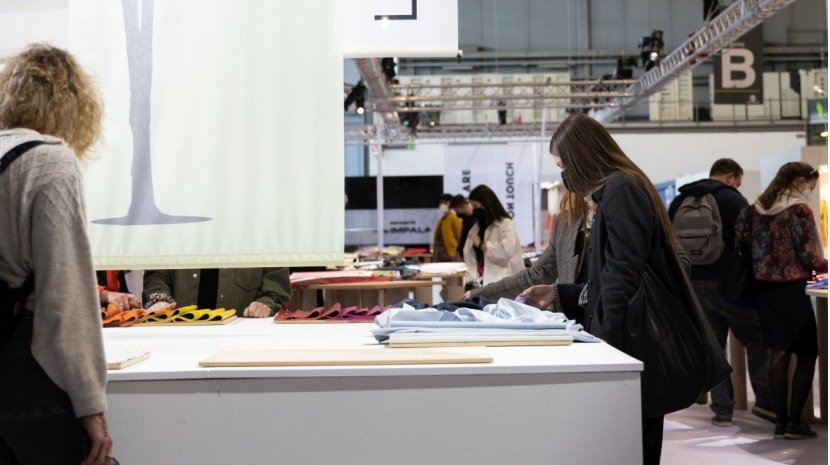
The 100th edition of Lineapelle closed on a very
positive note. In total, 1 134 exhibitors (960 registered in February
2022) from 40 countries presented their autumn/winter 2023 trends from
the 20th to the 22nd of September.
The
fair received 32% more visitors than in February and saw a 73% growth
in foreign visitors, with the highlight being the increase in visitors
from the United States, India, Mexico, Turkey, and the most relevant
European markets (France, United Kingdom, Portugal and Spain). The
organization revealed that one of the most interesting data of this
edition was the age of the visitors; they are increasingly younger. For
the fair, this is "an important signal for the future of Lineapelle and
the entire supply channel”.
Fulvia
Bacchi, CEO of Lineapelle, stated that "it was a beautiful, lively fair,
rich in contents and prospects, with pavilions attended from the very
first minute by a crowd of interested, convinced operators, coming, as
in the past, from all over the world”. The return of Asian buyers and a
"higher influx of visitors than usual" gave a new spirit to the sector,
which operates upstream of the footwear industry.
A
total of 35 Portuguese companies attended the most important
international fair for leather, footwear accessories and components. In
the entourage, there were newcomers. Marqsol was in Lineapelle for the
first time. The 2-years-old components company, which is dedicated to
the production of soles for footwear, is now investing in a new
generation of products where "everything can be introduced in the
production”.
Multicouro,
from São João da Madeira, is a regular at the fair. Rodolfo Andrade
states that business "is very good” and that, thanks to new customers
and the increase in sales, the company's turnover is already about 20%
above the pre-pandemic period. "The balance of the fair is very
positive, especially due to the return of some customers who did not
attend since February 2020, such as the Asian ones. So far, we have not
yet noticed a drop in demand or interest in seeing new collections, but
the main topic of conversation is the uncertainty, the war, the
reduction in purchasing power, and how this may influence demand in the
short term”, he says.
An
opinion shared by Pedro Castro, from Aloft. "The general opinion is
that it already felt like one of those "old-fashioned fairs”. Many
people turned up to discuss orders. However, there is also some fear of
the clouds that are coming, but what I saw, on the way back to the
airport, was that everyone had a smile on their face, a sign that the
mood was quite positive”. On the other hand, the responsible for the
company states that "we managed to close subjects that had been a long
time to be finished, which only proves that the physical is always the
physical".
For
Paulo Ribeiro, responsible for Atlanta, the participation in the fair
"was very positive”, having exceeded expectations. "We noticed a greater
influx of visitors. It was an excellent opportunity to make new
business contacts, to show our innovative and increasingly sustainable
products, which are constantly being adapted, and better understand
market trends and visitor’s concerns”, says Paulo Ribeiro.
Sustainability
The components industry shows great dynamism concerning sustainability and, in each edition of Lineapelle, new developments are not long in coming. "Sustainable innovation is not just about materials, it also concerns the production process and the way products are used. It is a continuous process that also considers the entire supply chain. The fashion industry needs to be more sustainable, reducing waste," stresses Vitor Mendes, CEO of ISI Soles.
The components industry shows great dynamism concerning sustainability and, in each edition of Lineapelle, new developments are not long in coming. "Sustainable innovation is not just about materials, it also concerns the production process and the way products are used. It is a continuous process that also considers the entire supply chain. The fashion industry needs to be more sustainable, reducing waste," stresses Vitor Mendes, CEO of ISI Soles.
In this
company's new collection, the highlight is in the models of soles for
shoes that incorporate waste from other industries, such as cork,
rubber, rice husks, tennis balls or even balloons from parties and
birthdays. "The incorporation of sustainable materials, which are often
more versatile than traditional options, allow us to create new styles
without sacrificing quality”, claims Vitor Mendes. In the development of
the collection, all materials used were "selected with great care, so
they can provide maximum comfort, durability, and performance”, he adds.
Soviras,
a company specialized in the production of straps for shoes, also
introduced a sustainable line by "giving a second life to waste, reusing
them in the manufacture of new straps. Combocal, which has also
invested in sustainability, presented solutions produced with banana
fibre, rice husk, and cork.
Back at the
fair, Forever showed that has been as well investing in recycled and
bio-based solutions. But, in the case of the Vila Nova de Gaia company,
even the stand was built with 73% recycled material, and 87% of it can
be recycled again.
Environmental concerns
Inflation
and the war in Ukraine are the main concerns of companies. For the
Portuguese Association of Tannery Manufacturers (APIC), given the effect
of inflation on household income, the future is very uncertain. "Unlike
what happened during the pandemic, when people were able to roughly
maintain their incomes with lay-off measures, income is now being eroded
by inflation”, says Gonçalo Santos. The secretary-general of APIC
admitted that the industry fears "a demand crisis, as people will not
have enough income to channel to non-essential goods such as footwear or
leather goods, the main customers of the tanning sector.
Rodolfo
Andrade is also "apprehensive” with the increase of inflation and the
consequent fall of family incomes, since 95% of the company is intended
to supply footwear companies.
In
the case of Aloft, due to the company’s business model, the concern is
not so immediate. The company specializes in technical soles, many of
which are subject to demanding certifications, which, in many cases,
presuppose long-term contracts that can reach ten or fifteen years. This
fact makes the company slightly 'more immune to the more immediate
conjuncture'. Nonetheless, Pedro Castro admits that some worrying signs
are beginning to emerge. "Fearing a failure of raw materials or
production capacity, many customers assumed higher than normal levels of
intermediate stocks, creating the perfect storm. Many customers had
inflated growth forecast models, and are now revising them to adjust to
the demand”, he explains.