
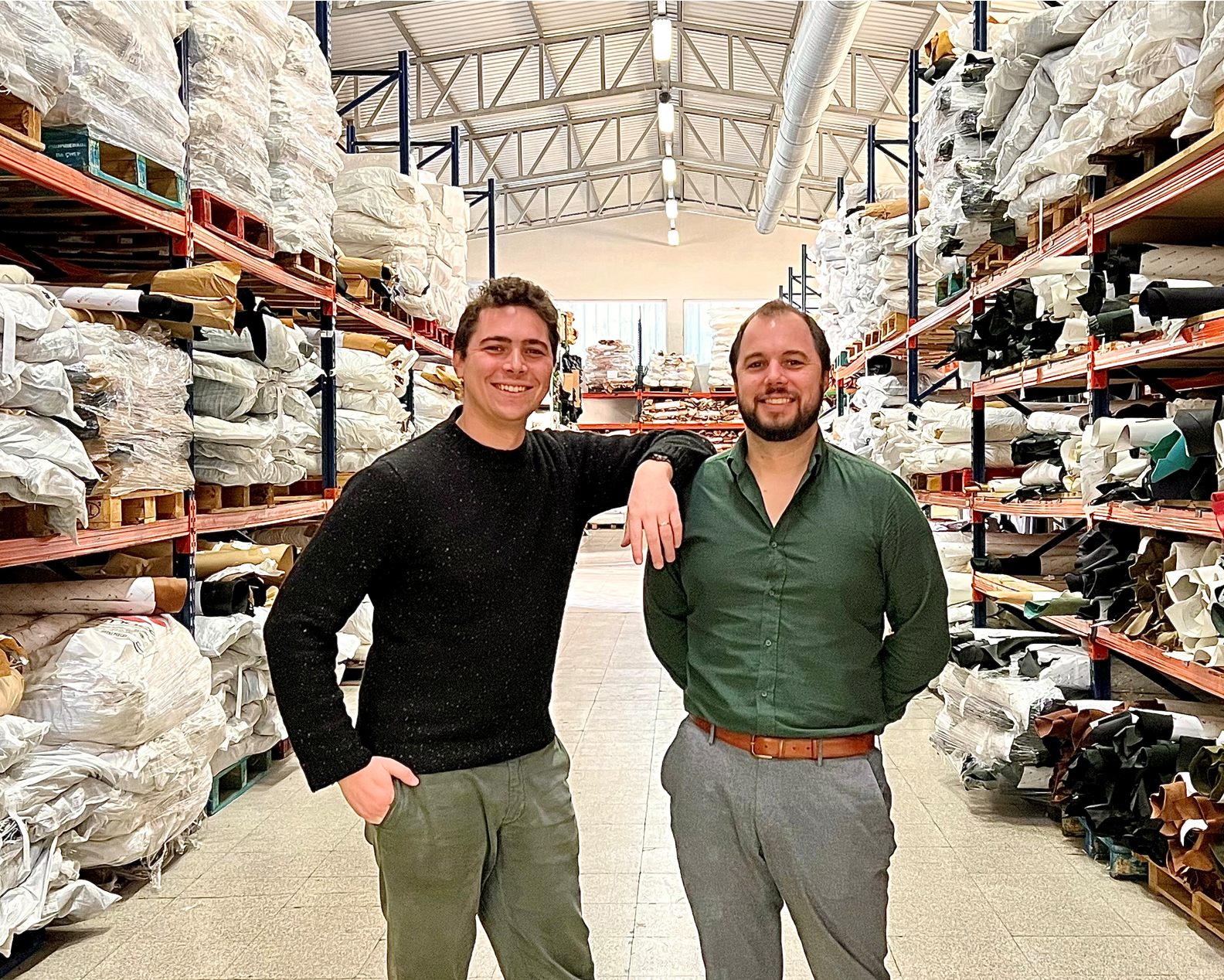
Carlos Oliveira and Sérgio Oliveira are brothers, young, and the new generation at the helm of SIMACA, a tanning company located in S. João da Madeira. Carlos, with a degree in Economics and a post-graduate qualification in International Economics, has worked in the family business for ten years. Sérgio studied Management and later took a master’s in Brand Management and Communication at the Copenhagen Business School, returning to Portugal after seven years in Denmark to embrace the family business, where he has been for two years now.
Was working in the company a first choice? Why?
Carlos: Since it was founded in 1984, Simaca has always been part of my life, I grew up with the company all around me. However, despite having an academic background related to SIMACA, I looked first for other realities to open horizons, so joining the company was not then a priority. I worked within the corporate banking sector for 6 years, which allowed me to learn a lot about different sectors of our economy. In 2012, the possibility of supporting Simaca in its remodelling and structuring process to meet the challenges we were already anticipating arose. Since then, there has been total dedication on my part.
Sérgio: I never prioritized going into the family business, perhaps because I am the youngest son. It was actually something that I considered a bit remote, so I spent seven years in Denmark, where I worked for four years in the commercial area of an Immersive Technologies start-up. During the COVID-19 pandemic period, I decided to return to Portugal to be closer to my family and see my nephews growing up. It was then that my father showed me SIMACA’s internationalization project. I had already worked in the commercial area, so I thought I could bring added value to the company while embracing an interesting challenge.
What are currently the main challenges of the tanning sector?
Carlos: As far as our sector is concerned, much has been done to make the industry cleaner, sustainable, and dynamic. A big challenge is to convey this message to the final consumer. In today’s society, where the environmental focus is a relevant factor, leather is not perceived as a recycled product (a by-product of the food industry) with a durability far superior to other synthetic compounds. I admit that the new leather substitute products are more efficient in this task, even if they don’t have the same performance and are mostly produced from oil derivatives.
You have recently competed in the CTCP Metal Shoe FabLab project. What was your proposal based on?
Sérgio: We participated with our customizable leathers’ project. We tried to understand along with CTCP which of our leathers had the potential to be customized, so we conducted three studies: laser engraving, digital printing (UV), and 3D printing of TPU filament. In the end, we were able to work out the limitations of certain leathers and which ones would be the most suitable for different purposes. This allowed us to launch a leather specially developed for UV digital printing that is also washable at 30ºC. This is ideal for medical footwear, where it is normal for healthcare professionals, for hygiene reasons, to want to wash their work clothes as soon as they get home from work. Thus, this leather enables professionals to continue wearing a noble and comfortable material on their feet while feeling safe.
What do you think this new generation entering now into the sector has to offer?
Carlos: The industry is constantly changing. Dynamism and speed are key to success. The new generation is sharp and adapts very quickly to new market scenarios.
Sérgio: Two things: a fresh vision of the business and a mastery of new tools, which will enable them to drive a faster and more expansive change in processes and markets. This new generation of professionals has grown in a globalized world, with tools previous generations didn’t have. The existing numerous online platforms and different business models can serve on a large scale to change internal processes and open horizons for new markets in a simpler and faster way.
What advice would you give to a young person starting in the industry?
Sérgio: To have an open mind and critical spirit. The sector has professionals with a lot of experience, so the entrance of new ones may generate some kind of generational conflict. In this sense, it is essential to enter the market with an open mind to learn from previous generations. By this, I don't mean that only previous generations know how to do it, and that is where the critical spirit comes in, which will help them to distinguish what to retain and what to change.
Carlos: I somewhat agree with my brother, but being a little more mature, I would add knowing how to listen. Although the changes in the footwear sector are huge and sudden, there is still much that the older generations can contribute and teach us if we are willing to learn.
Was working in the company a first choice? Why?
Carlos: Since it was founded in 1984, Simaca has always been part of my life, I grew up with the company all around me. However, despite having an academic background related to SIMACA, I looked first for other realities to open horizons, so joining the company was not then a priority. I worked within the corporate banking sector for 6 years, which allowed me to learn a lot about different sectors of our economy. In 2012, the possibility of supporting Simaca in its remodelling and structuring process to meet the challenges we were already anticipating arose. Since then, there has been total dedication on my part.
Sérgio: I never prioritized going into the family business, perhaps because I am the youngest son. It was actually something that I considered a bit remote, so I spent seven years in Denmark, where I worked for four years in the commercial area of an Immersive Technologies start-up. During the COVID-19 pandemic period, I decided to return to Portugal to be closer to my family and see my nephews growing up. It was then that my father showed me SIMACA’s internationalization project. I had already worked in the commercial area, so I thought I could bring added value to the company while embracing an interesting challenge.
What are currently the main challenges of the tanning sector?
Carlos: As far as our sector is concerned, much has been done to make the industry cleaner, sustainable, and dynamic. A big challenge is to convey this message to the final consumer. In today’s society, where the environmental focus is a relevant factor, leather is not perceived as a recycled product (a by-product of the food industry) with a durability far superior to other synthetic compounds. I admit that the new leather substitute products are more efficient in this task, even if they don’t have the same performance and are mostly produced from oil derivatives.
You have recently competed in the CTCP Metal Shoe FabLab project. What was your proposal based on?
Sérgio: We participated with our customizable leathers’ project. We tried to understand along with CTCP which of our leathers had the potential to be customized, so we conducted three studies: laser engraving, digital printing (UV), and 3D printing of TPU filament. In the end, we were able to work out the limitations of certain leathers and which ones would be the most suitable for different purposes. This allowed us to launch a leather specially developed for UV digital printing that is also washable at 30ºC. This is ideal for medical footwear, where it is normal for healthcare professionals, for hygiene reasons, to want to wash their work clothes as soon as they get home from work. Thus, this leather enables professionals to continue wearing a noble and comfortable material on their feet while feeling safe.
What do you think this new generation entering now into the sector has to offer?
Carlos: The industry is constantly changing. Dynamism and speed are key to success. The new generation is sharp and adapts very quickly to new market scenarios.
Sérgio: Two things: a fresh vision of the business and a mastery of new tools, which will enable them to drive a faster and more expansive change in processes and markets. This new generation of professionals has grown in a globalized world, with tools previous generations didn’t have. The existing numerous online platforms and different business models can serve on a large scale to change internal processes and open horizons for new markets in a simpler and faster way.
What advice would you give to a young person starting in the industry?
Sérgio: To have an open mind and critical spirit. The sector has professionals with a lot of experience, so the entrance of new ones may generate some kind of generational conflict. In this sense, it is essential to enter the market with an open mind to learn from previous generations. By this, I don't mean that only previous generations know how to do it, and that is where the critical spirit comes in, which will help them to distinguish what to retain and what to change.
Carlos: I somewhat agree with my brother, but being a little more mature, I would add knowing how to listen. Although the changes in the footwear sector are huge and sudden, there is still much that the older generations can contribute and teach us if we are willing to learn.