
Portuguese Fashion brings Tradition, Innovation and Sustainability to the United Nations
30 Sep 2026
News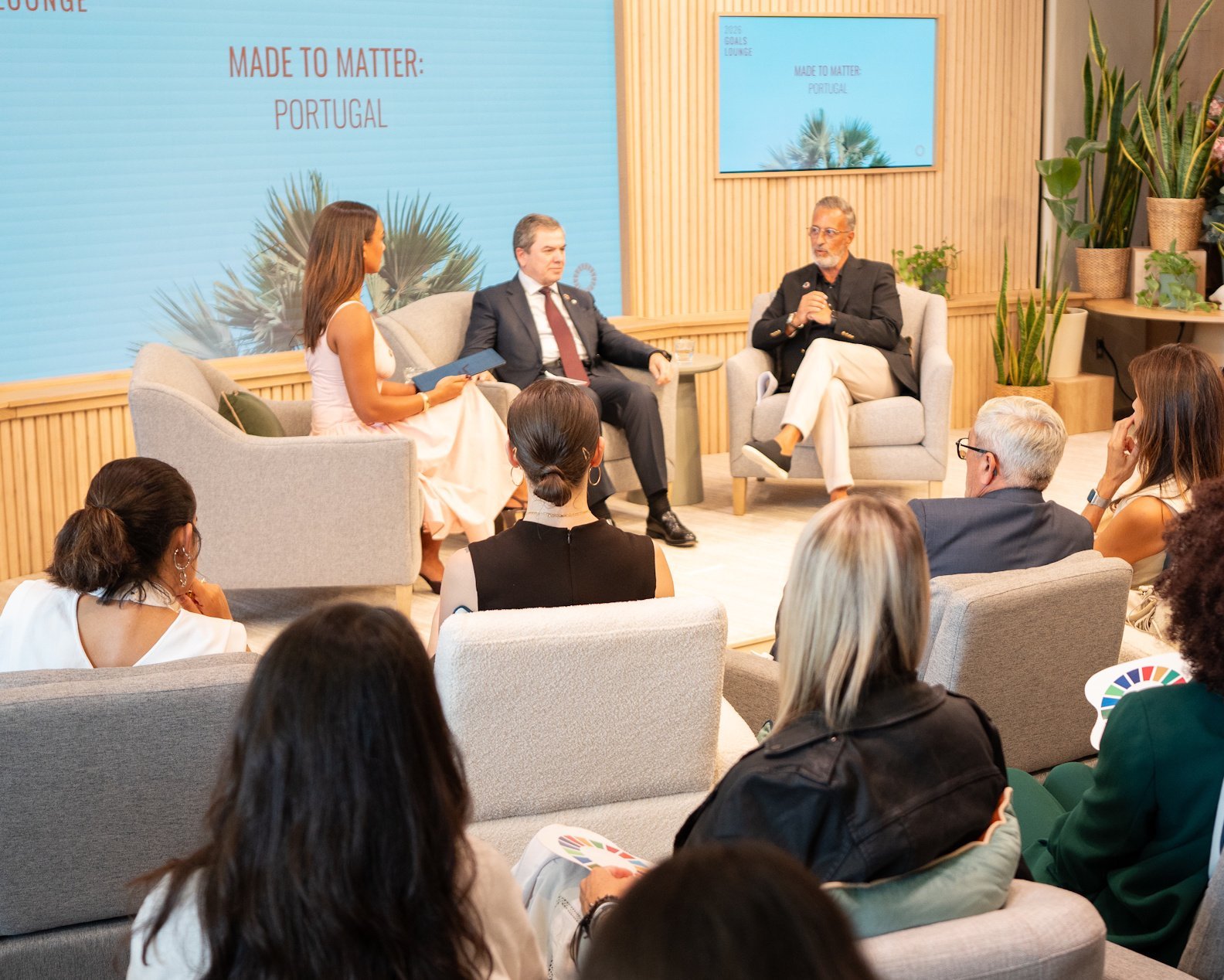
The Portuguese fashion industry took centre stage at the United Nations in New York on 10 September with "Made to Matter: Portugal”, an initiative held alongside New York Fashion Week and as part of the annual meeting of the United Nations Fashion and Lifestyle Network.
Promoted by APICCAPS and the Textile Intelligence Centre (CENIT), with the support of the Portuguese Trade & Investment Agency (AICEP), the event brought together industry representatives, designers, researchers and professionals involved in promoting Portugal internationally.
The conference aimed to showcase the transformation of the Portuguese fashion industry on the international stage and discuss Portugal’s role in addressing the challenges shaping the sector’s future. Throughout the event, topics including innovation, sustainability, new materials, technology, craftsmanship, proximity manufacturing and collaboration across the value chain were explored, highlighting how tradition and industrial expertise can be combined with research and innovation.
Participants included César Araújo, Chairman of the Executive Committee of the Projeto Lusitano consortium; Luís Onofre, President of APICCAPS; Carlos Moura, from AICEP; Joana Frazão Duarte, founder and Creative Director of Béhen; designer and entrepreneur Armando Cabral; Maria José Ferreira, Research Director at the Portuguese Footwear Technology Centre (CTCP); and Kaleigh Tirone Nunes, from Petratex. The programme also featured Annemarie Hou, Executive Director of the UN Office for Partnerships, and Vera Ávila, Deputy Permanent Representative of Portugal to the United Nations.
Under the theme "Made to Matter”, the initiative sought to showcase internationally a sector encompassing textiles, clothing, footwear, components and leather goods, which has been steadily increasing its investment in knowledge, technology and sustainability. More than simply presenting products, Portugal brought to the United Nations an industrial model built on a combination of know-how, manufacturing capabilities, innovation and a growing commitment to addressing fashion’s environmental and social impact.
An Industry Built on an Integrated Value Chain
For César Araújo, one of the distinctive characteristics of Portuguese industry lies precisely in the close connections between the different elements of its value chain:
"I think that when we talk about Portuguese industry, we have to talk about the entire ecosystem, because we have a very strong and highly integrated value chain. We have companies working together, we have knowledge, and we have an industry that has been built over many decades. On top of that, we have a team of people who are passionate about making fashion. That passion is also reflected in the product. When we produce a garment or a pair of shoes in Portugal, we do it with heart.”
Araújo stressed that this structure enables Portuguese industry to go beyond manufacturing and focus on creating value. Sustainability was, in fact, one of the central themes of the session. In his view, it must be approached holistically, encompassing materials, manufacturing processes, energy and water.
The close relationship between manufacturers, designers, suppliers, technology centres and universities is also, in his view, one of Portugal’s competitive advantages:
"We have the designers, we have the manufacturers, we have the suppliers, we have the technology centres and we have the universities. We can all work together. And that allows us to be much faster.”
Luís Onofre, President of APICCAPS, also highlighted the adaptability of an industry that has had to respond to a wide range of challenges over recent decades:
"I think one of our main advantages is our ability to adapt. We are a very resilient industry. We have the ability to find solutions. And we have great persistence.”
In a market where price alone is no longer enough to differentiate production, Onofre pointed to other competitive factors:
"Today, we can no longer compete on price alone. We have to compete on quality, design, innovation and our ability to respond quickly to our customers’ needs.”
Proximity to markets and the ability to manufacture small quantities are other strengths highlighted by Luís Onofre. Portugal has "an industry that is very close to its markets” and is able to "produce small quantities”, something that is "very important, particularly when we are talking about brands looking for differentiated products”.
The APICCAPS President also stressed that sustainability cannot be reduced to the choice of a particular material:
"We cannot simply look at a product and say, ‘This product is sustainable because it uses a particular material.’ It is much more complex than that.”
Local production, working conditions, materials and manufacturing processes must, he argued, all be considered together.
From Research to Production
Maria José Ferreira, from the Portuguese Footwear Technology Centre (CTCP), presented the BioShoes4All project as an example of a value chain working to transform waste into new materials and solutions.
The project involves 69 partners, including companies and research institutions, and focuses on areas such as biomaterials, circularity and new manufacturing processes. Examples presented included the use of pine bark and coffee grounds to produce agents used in leather treatment.
Ferreira argued that innovation depends on collaboration across different areas:
"We need researchers to provide knowledge and develop materials or technologies. We need designers to create designs that consumers will embrace. We need the people in production because they know how to manufacture. We need the brands. And we need consumers. We need everyone working together.”
Bringing research to market, however, remains one of the challenges:
"Because an innovation that remains unused, that is not sold and does not reach consumers is not innovation. This collaboration is fundamental.”
For Kaleigh Tirone Nunes, from Petratex, Portugal already has technological solutions capable of scaling up, but greater demand from brands is still needed:
"The innovation exists and, in Portugal, it is ready to scale — or has already scaled. What is missing is demand. What is missing is for brands to embrace these solutions.”
Sustainability Starts with Design
Kaleigh Tirone Nunes also highlighted the need to change the way sustainability is approached, placing it at the very beginning of the product development process:
"It starts at the planning stage. It starts by asking: How well do you know your customer? What do they want? What will be the future of the products you are creating? And how can you plan better to create less waste?”
Luís Onofre also advocated a broader approach to sustainability, encompassing local production, working conditions, materials and manufacturing processes.
César Araújo added that sustainability must be supported by data and evidence, from water and energy consumption to carbon footprint and product end-of-life. The industry, he argued, must be able to measure the impact of its choices in order to demonstrate results.
Know-How as Heritage
The importance of accumulated knowledge and the human dimension of the industry was another point highlighted by César Araújo, "because, at the end of the day, it is people who make the industry”:
"We have knowledge that has been accumulated over generations. But we have to be able to pass that knowledge on to new generations.”
Craftsmanship was particularly prominent in the contribution of designer Joana Frazão Duarte, founder of Béhen, who works with traditional Portuguese techniques and artisans from different regions of the country. Her aim, she explained, is to bring this heritage closer to younger generations and incorporate it into a contemporary language.
For the designer, there is little point in creating or putting clothing on the market without a clear intention behind it:
"Obviously, it is important for me to think about design because, once again, the younger generation needs to look at these pieces and think, ‘This is cool, I want to wear it.’ That is the goal. Design first.”
For Joana Frazão Duarte, preserving craftsmanship also means recognising the work and knowledge of the women who keep these techniques alive:
"It is not simply something they do before dinner or anything like that. It is art. And it takes a lot of time. And time is the greatest luxury, in my opinion.”
Portugal as a Manufacturing and Luxury Destination
Footwear designer Armando Cabral also highlighted the relationship between manufacturing, authenticity and Portugal. Having initially produced his brand between Portugal and Italy, the designer is now working to move production to Portugal.
Cabral believes that international perceptions of Portuguese industry have also changed:
"For many years, people in the industry knew Portugal as a Plan B for cheap labour or lower-cost production. Fast-forward to today, thanks to all the great work APICCAPS has been doing, people now know Portugal for what we actually do well.”
Portugal’s manufacturing heritage, he added, can also contribute to the value associated with luxury:
"It is a country with an enormous heritage and a great tradition of manufacturing stretching back hundreds of years. And many of the major brands now manufacture in Portugal. We have these family-owned companies that remain true to what they do. And I think that is also where luxury and authenticity come from, which is really what Portugal provides.”
Taking Portuguese Industry to the World
Closing the event, Carlos Moura, from AICEP, highlighted the strengths of Portuguese footwear and fashion, rooted in "innovation, craftsmanship, talent, industrial capability, creativity and sustainability”.
The AICEP representative also argued that sustainability must be understood beyond materials alone, encompassing water and energy consumption as well as working conditions. He also identified internationalisation as one of the key objectives for the future:
"Our goal is to build on these strengths in the future and create connections between these companies and Portuguese talent and international markets, with the international industry, and increasingly showcase all of this around the world.”
The session concluded with remarks from Vera Ávila, Deputy Permanent Representative of Portugal to the United Nations, who summed up the event’s message by highlighting the connection between tradition, innovation and fashion:
"I think the main conclusion we can draw from this is understanding just how much tradition, innovation and fashion — which we all love — can go hand in hand.”
For the diplomat, combining craftsmanship with technology is one of the foundations for a more sustainable industry:
"I think what we have done today, as Portuguese, is demonstrate how craftsmanship and technology, when brought together, are effectively contributing to a sustainable fashion industry.”
The "Made to Matter” concept, she added, also seeks to move away from the logic of fast consumption:
"‘Made to Matter’ creates products whose value goes beyond the fast fashion cycle of a single season.”
Portugal’s presence at the United Nations therefore concluded with a message of international collaboration:
"But we cannot do it alone. That is why it is so important to be here at the United Nations, because we have to do it together. It does not work if only one country is doing it.”
Luís Onofre also stressed that Portugal has succeeded in demonstrating that there is "a different way of producing. A way based on quality, knowledge, innovation, sustainability and people.”
"We must continue doing what we know how to do and continue working with our international partners,” he added, because "Portugal is not alone.”