
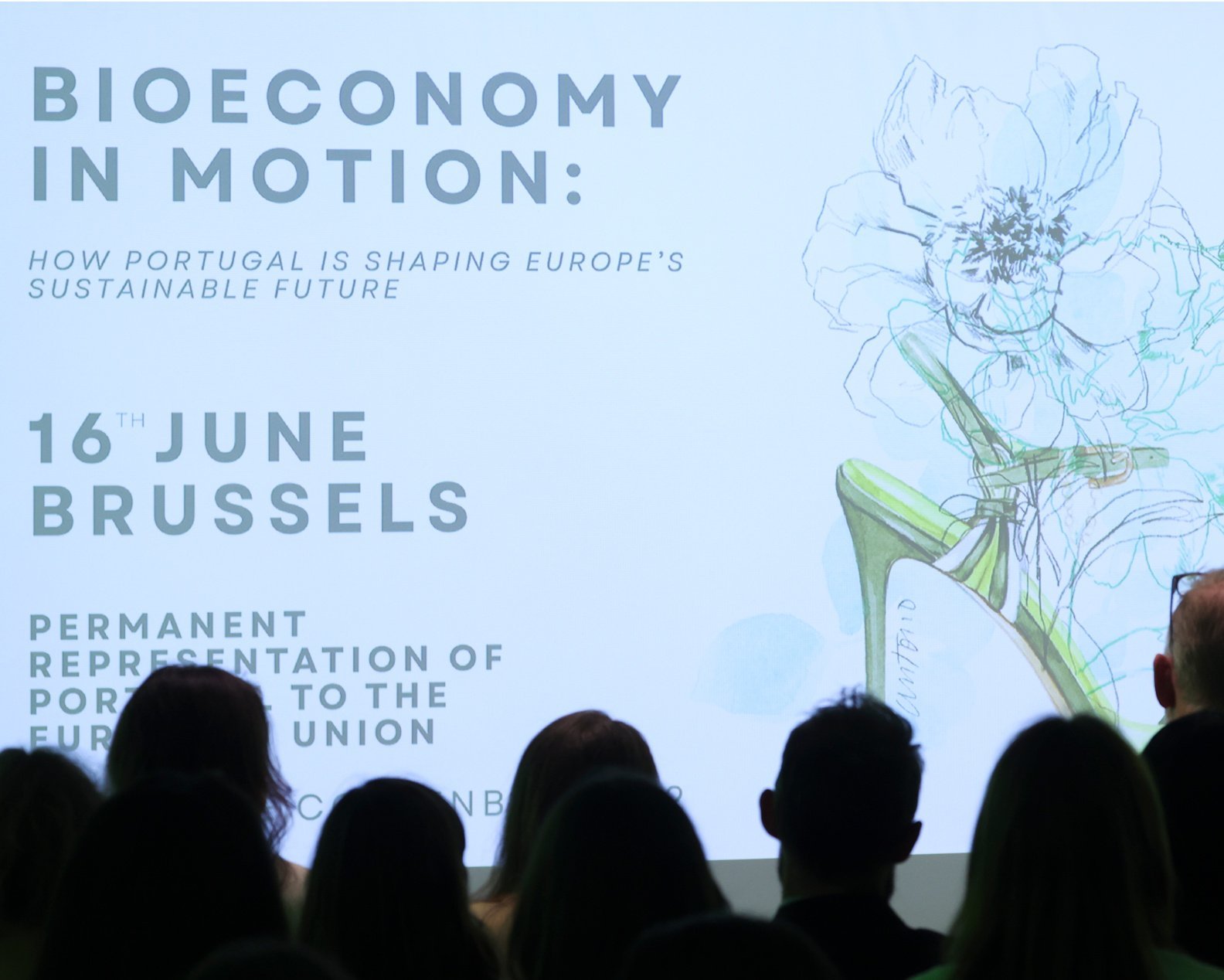
Brussels hosted the conference "Bioeconomy in Motion: How Portugal is Shaping Europe's Sustainable Future," an initiative organised by APICCAPS, the European Confederation of the Footwear Industry (CEC), and the Portuguese Footwear Technology Centre (CTCP). The event showcased the results of the largest investment programme ever undertaken by the Portuguese footwear industry in the fields of innovation, sustainability and the bioeconomy.
Before an audience of European institution representatives, policymakers, business leaders and researchers, the Portuguese footwear industry presented the outcome of a transformation process that mobilised more than €70 million in investment over recent years, much of it supported by Portugal's Recovery and Resilience Plan (RRP).
"While many are discussing the future, we chose to build it," said Luís Onofre, President of APICCAPS, arguing that Portugal is demonstrating in practice how Europe's reindustrialisation can become a reality. "Europe talks about reindustrialisation. Portugal is making it happen."
According to Onofre, the Portuguese footwear industry deliberately chose a different path from many of its international competitors. "Portugal did not choose to compete on price. It chose to compete through knowledge, innovation, sustainability, technology and creativity," he said.
It was this vision that gave rise to BioShoes4All, one of the largest collaborative projects ever developed by the Portuguese manufacturing sector, bringing together companies, technology centres, universities and brands around a common ambition: to develop the footwear of the future. "More sustainable, smarter, more transparent and more European," Onofre summarised.
At a time when the European Union is seeking to reduce external dependencies, strengthen strategic value chains and rebuild industrial capacity, Portugal's experience was presented as tangible proof that industry remains part of the solution. "A solution for competitiveness, innovation, skilled employment and Europe's strategic autonomy," he noted.
The conference took place just days after the European Commission presented its new Bioeconomy Strategy. For Luís Onofre, this agenda is deeply connected to both the history and the future of the footwear industry.
"Bio-based products are at the very origin of the footwear industry. Leather was probably the first industrial material and remains an outstanding example of how a by-product of the food industry can be successfully valorised," he said.
The President of APICCAPS argued that BioShoes4All demonstrates that a bio-based economy is both possible and commercially viable in Europe. Over the past few years, the project has delivered new biomaterials, circular solutions, more efficient manufacturing processes and digital tools designed to reduce the environmental footprint of the footwear industry.
The conference also reinforced the message that Europe's reindustrialisation must move beyond ambition and into implementation.
"Reindustrialisation cannot remain just a slogan. It must become a policy, a commitment and a priority," Onofre stressed, calling for a Europe that supports companies that manufacture, invest and innovate, while safeguarding competitiveness throughout the green transition.
Closing the conference, the President of APICCAPS delivered a clear message to European decision-makers:
"Europe's future should not be imported. It should be conceived, developed and manufactured in Europe."
A conviction supported by the Portuguese footwear industry's recent transformation and its ambition to continue positioning itself as a European benchmark for a more sustainable, technologically advanced and competitive manufacturing sector.